 Return home
Return home
Return homeYou need to consider several things when planning how to charge your fleet.
You need to consider several factors when planning how to charge your fleet. The most suitable charging approach will depend on how the vehicles are used, including their mileage, the amount of time they spend in operation, and where they are parked when not in use.
Installing charging infrastructure can be expensive, so it is important to ensure the number of charge points meets fleet requirements without significantly exceeding them.
The simplest approach is to provide one charge point socket for each vehicle. This one-to-one ratio can help make the transition from internal combustion engine (ICE) vehicles to battery electric vehicles (BEVs) as straightforward as possible.
Staff engagement is critical to the successful adoption of BEVs and the delivery of a wider decarbonisation strategy. Providing a dedicated socket for each vehicle helps simplify charging and avoids staff having to search for an available charge point when vehicles return from service.
This approach often involves installing basic charge points that operate at their maximum rated power. However, the combined power rating of all charge points must remain within the site’s available electrical capacity.
One challenge with this arrangement is that it can create peaks in electricity demand. If multiple vehicles begin charging at the same time, they will all attempt to draw maximum power.
If additional charge points are required beyond the site’s available capacity, a larger grid connection may be needed. This can be costly and may result in standing capacity charges or the need for a new electricity substation.
Individual charge points can be manually restricted to operate below their rated power to remain within site limits. However, this can be inflexible if charging requirements change or vehicles need to be recharged more quickly.
An effective load management system can allow more charge point sockets to be installed without increasing the grid connection. This can enable more vehicles to charge simultaneously at lower charging speeds, particularly overnight.
When fewer vehicles are connected, a load management system can allocate more power to those that are charging, providing greater flexibility than permanently restricting charge point outputs.
A dynamic load management system can also help avoid costly grid upgrades by making use of spare electrical capacity elsewhere on the site. For example, unused capacity from offices or buildings can be redirected to vehicle charging when demand is low. This approach requires real-time monitoring of site electricity consumption and typically provides the greatest flexibility, although it is usually the most expensive load management option.
Depot A has an electricity supply capacity of 150 kVA. Assuming a power factor of 95%, the maximum site demand would be 142.5 kW.
A site office at Depot A uses 52.5 kW during the day for lighting and heating and 12.5 kW overnight.
This leaves 90 kW available for static charging. With this capacity, the depot could charge 12 vehicles using 7.4 kW charge points.
The site office at Depot A uses 52.5 kW during the day for lighting and heating and 12.5 kW overnight, leaving an additional 40 kW of spare capacity available overnight.
Using dynamic load management, this spare capacity could be used to charge five additional vehicles using 7.4 kW charge points overnight, alongside the 12 vehicles already charging using the site’s static charging capacity.
As of December 2023, there were 4,495 public charge points in Scotland, according to Zapmap. Scotland’s public electric vehicle (EV) charging network, ChargePlace Scotland (CPS), includes a range of charger types, including standard, fast and rapid chargers. There are also many privately operated public charge points available across the country.
Although some battery electric vehicles (BEVs) can now achieve ranges of up to 345 miles, with average ranges of around 200 miles, some journeys will still require access to public charging infrastructure. This may apply to fleet vehicles travelling long distances, as well as employees who keep vehicles at home but cannot install a home charge point.
The public charging network continues to expand, helping to ensure that drivers are rarely far from a charge point. Before travelling to a charger, drivers should check its location and availability using a charge point app or website, such as Zapmap or ChargePlace Scotland.
Figure 3 shows charge points on the ChargePlace Scotland network. It is not a complete map of Scotland’s public charging infrastructure, as other charge point operators also provide public charging services.
To access the ChargePlace Scotland network, drivers require either a ChargePlace Scotland card or the ChargePlace Scotland app. Alternatively, drivers can use the WebPay service to pay for charging without creating an account.
ChargePlace Scotland cards can be linked to a company account, allowing employees to use public chargers without paying directly. Cards can be assigned to either a vehicle or an individual employee, enabling energy consumption to be monitored and reported.
Most modern electric vehicles can travel well over 100 miles on a single charge. As a result, some fleet vehicles may not need to be charged every day.
Introducing a charging rota can help reduce the number of charge points required by allocating charging times to specific vehicles.
Keeping any rota system simple will make it easier for staff to follow. For example, vehicles could be assigned the same charging times each week. Additional measures can also be introduced to prevent charge points being occupied by vehicles that do not need charging.
A process should be put in place for essential or unexpected charging requirements to avoid situations where a vehicle needs to be charged but no charge point is available. Installing a small number of reserve charge points, or a rapid charger where appropriate, can help reduce this risk. Using the public charging network when on-site infrastructure is unavailable may also be an option.
Managing this approach effectively will require smart charge points that can monitor and control charging activity. Smart charging systems can also stagger charging sessions to reduce demand on the electricity network and enable organisations to benefit from time-of-use electricity tariffs.

Using a charging rota can significantly reduce the number of charge points required across a fleet.
Analysis of public sector fleets shows that many vehicles typically travel between 30 and 50 miles per day, excluding weekends. As a result, some vehicles may only need to be charged every second or third day.
Charging a vehicle overnight for 12 hours using a 3.7 kW charge point can deliver approximately 44 kWh of electricity, which is enough energy to provide around 133 miles of driving range*.
To determine which vehicles are suitable for rota-based charging, you should understand the maximum daily mileage of each vehicle and how often charging is required. Installing telematics can provide valuable data on vehicle usage and driving patterns, helping to inform charging strategies.
*Based on an average energy consumption of approximately three miles per kWh.
A home charging solution will often be needed for employees who take fleet vehicles home. This can present additional challenges, including how vehicles are charged and how staff are reimbursed for electricity used.
You should first determine whether fleet vehicles need to be taken home by employees. Where they do, staff with access to off-street parking should be supported to install a home charge point. Employees who cannot install a home charger are likely to rely more heavily on the public charging network.
The typical cost of purchasing and installing a home charge point is around £1,000. The Office for Zero Emission Vehicles (OZEV) currently provides grant support for eligible residents living in flats and rental accommodation through its home charging schemes. Scottish residents may also be eligible for additional support through Energy Saving Trust’s domestic charge point funding.
When reimbursing employees for charging fleet vehicles at home, the advisory fuel rate (AFR) for battery electric vehicles (BEVs) is 10 pence per mile. Hybrid vehicles are treated as either petrol or diesel vehicles for mileage calculations. You can check the latest advisory fuel rates on GOV.UK. Combining telematics data with these rates can help organisations accurately reimburse business mileage.
Other options include using a third-party payment provider linked directly to an employee’s energy supplier. Under this model, employees can charge vehicles at home or on the public charging network without paying for electricity costs themselves. The provider invoices the employer directly for the electricity consumed across both home and public charging. This approach has been trialled by Mitie and Mina, as described in this Fleet World case study.
Another option is neighbourhood charge point sharing through platforms such as Co Charger. This allows people without off-street parking to access a neighbour’s charge point. While still an emerging model, it may provide an alternative or complementary solution alongside the public charging network.
Charging solutions continue to evolve rapidly. It is important to keep up to date with new technologies, services and funding opportunities to identify the most effective options for your organisation and employees.

As of December 2023, there were 4,495 public charge points in Scotland, according to Zapmap. Scotland’s public electric vehicle (EV) charging network, ChargePlace Scotland (CPS), provides a range of charger types, including standard, fast and rapid chargers. There are also many privately operated public charge points available throughout the country.
Although some battery electric vehicles (BEVs) can achieve ranges of up to 345 miles, with an average range of around 200 miles, drivers will occasionally need to travel further. Fleet vehicles undertaking longer journeys may therefore need to use the public charging network. Employees who take vehicles home but cannot install a home charge point are also likely to depend on public charging infrastructure.
The public charging network continues to expand, helping to ensure that drivers are rarely far from a charge point. Before travelling to a charger, drivers should check its location and availability using an app or website such as Zapmap or placescotland.org/live-map/”>ChargePlace Scotland.
Figure 39 shows charge points on the ChargePlace Scotland network. It is not a complete map of Scotland’s public charging infrastructure, as other charge point operators also provide public charging facilities.
To access the ChargePlace Scotland network, drivers will need either a ChargePlace Scotland card or the ChargePlace Scotland app. Alternatively, drivers can use the WebPay service, which allows charging sessions to be paid for without a ChargePlace Scotland account.
ChargePlace Scotland cards can be linked to a company account, allowing employees to use public charge points without paying directly. Cards can be assigned to either a vehicle or an individual employee, enabling electricity consumption to be monitored and reported.

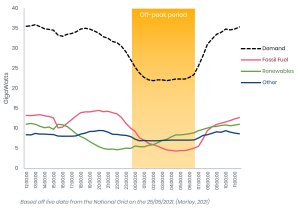
Ideally, fleet vehicles should be charged overnight to reduce the impact of charging demand on the electricity network.
Electricity demand on the UK grid is typically highest during the working day, between 6am and 11pm. During these periods, greenhouse gas (GHG) emissions associated with electricity generation may also be higher, as additional generation is required to meet demand.
Research suggests that fleet greenhouse gas emissions can be reduced by around 10% to 15% by avoiding charging during peak demand periods and instead charging overnight. However, as the electricity grid continues to decarbonise through increased renewable energy generation, the emissions savings associated with off-peak charging are expected to decrease over time.
During the summer months, on-site solar photovoltaic (PV) systems can be used to charge vehicles in the late afternoon and early evening, when building electricity demand is often falling as offices close and equipment such as lighting and computers are switched off.
Using electricity generated by on-site solar PV systems can reduce both energy costs and greenhouse gas emissions by decreasing reliance on grid electricity.