 Return home
Return home
Return homeDiscover vehicle-to-grid (V2G) charging technology and how it can provide greater grid flexibility while helping to reduce energy costs. Learn how electric vehicles can store and return electricity to the grid when needed, supporting more efficient energy management.
Explore Project Sciurus, the world’s largest vehicle-to-grid trial, which demonstrated how V2G technology can help organisations optimise energy use, integrate renewable electricity and generate additional value from electric vehicle fleets.
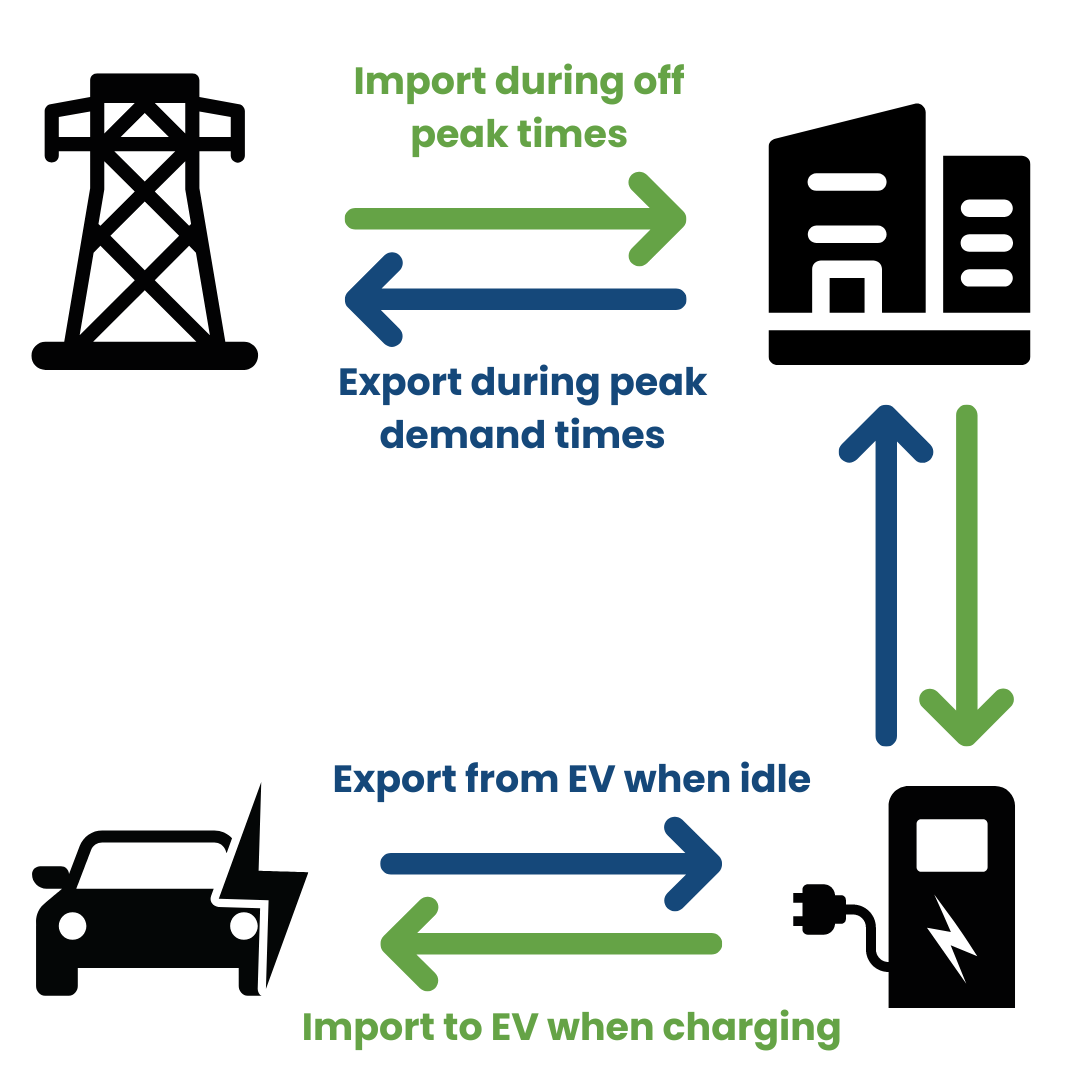
Vehicle-to-grid (V2G) chargers can both import electricity from and export electricity to the grid. They are similar in appearance to standard charge points but include bi-directional inverters that allow energy to flow to and from the vehicle. This enables an electric vehicle (EV) to act as a mobile energy storage unit, providing electricity to a home, business or the grid during periods of high demand.
In depot environments, V2G technology can also support load management. Where electricity supply capacity is constrained and vehicles use only a small proportion of their battery capacity each day, those vehicles can be used as temporary energy storage assets. Vehicles can be charged when electricity is cheaper and then supply energy to support charging for higher-mileage vehicles when required, while retaining enough charge to complete their own duties.
This approach can allow more vehicles to be charged simultaneously than would otherwise be possible using the existing grid connection. V2G systems can also maximise the benefits of time-of-use tariffs by shifting electricity consumption away from expensive periods and towards times when electricity prices are lower.
Vehicle-to-grid technology has significant potential to reduce energy costs and increase the use of renewable electricity. Vehicle manufacturers, including Nissan, are beginning to incorporate V2G capability into newer vehicle models.
Project Sciurus, the world’s largest domestic V2G trial at the time, has now concluded, although further trials and demonstration projects continue. Nissan and E.ON have previously worked with government and innovation partners to explore the commercial potential of V2G technology. For more information about the Department for Energy Security and Net Zero, visit Department for Energy Security and Net Zero.
You can explore successful projects from the V2X Innovation Programme:
Project Sciurus was the world’s largest vehicle-to-grid (V2G) trial and was delivered by OVO Energy, Nissan and Indra to investigate the potential financial and environmental benefits of domestic V2G charging. The three-year trial concluded in 2021 and used Nissan Leaf vehicles connected to 6 kW bi-directional charge points.
During the trial, participants plugged in their vehicles as normal while the charge point automatically imported or exported electricity. The system operated according to user preferences set through an app, ensuring that enough energy was available when the vehicle was needed.
The software optimised charging and discharging based on fluctuations in electricity demand, importing energy when demand was lower and exporting energy back to the grid during peak periods.
Participants saved an average of £420 per year. However, savings varied depending on how flexibly vehicles could be charged. Users who were able to leave vehicles connected for longer periods generally
