
 Return home
Return home
Return homeExplore smart electric vehicle (EV) charging using battery energy storage and solar photovoltaic (PV) systems. Discover Dundee’s innovative charging hub, which combines solar canopies, battery storage and flexible charging technology to support efficient, low-carbon transport.
If your charging requirements exceed the capacity of the local electricity network, an alternative to a costly grid connection upgrade is to install a charging solution that incorporates energy storage.
Energy storage systems, such as batteries, allow electricity to be stored when it is cheaper and has a lower carbon intensity. This stored energy can then be used to charge electric vehicles (EVs) at times when electricity from the grid is more expensive or carbon intensive.
Installing solar photovoltaic (PV) systems can increase the amount of renewable energy generated on site during daylight hours. This electricity can be stored and used later to charge vehicles, helping to reduce energy costs and emissions.
Solar PV can also be combined with load management systems, smart charging and vehicle-to-grid (V2G) technology to make the most effective use of on-site renewable energy.
Energy storage systems have finite capacity. Once the stored energy has been used, vehicle charging will depend on the site’s available grid connection capacity.
When considering energy storage, it is important to assess the amount of storage required to deliver the greatest benefit. This will depend on factors such as the size of the existing electrical connection, expected charging demand and the load management approach being used.
Although energy storage systems can involve a significant upfront investment, a well-designed solution may avoid the need for costly electricity supply upgrades and ongoing standing capacity charges, improving long-term value for money.
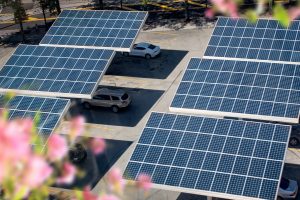
The charging hub opened in 2018 and was the UK’s first electric vehicle (EV) charging infrastructure project to combine solar canopies with battery energy storage.
The hub includes six 50 kW charge points and three 22 kW charge points. Each charge point has two connectors, allowing up to 18 EVs to charge at the same time.
The solar photovoltaic (PV) system can generate up to 36 kW of electricity, which is supplied to the on-site battery energy storage system. The battery can store up to 90 kWh of renewable energy. This stored energy is prioritised for charging connected EVs before any surplus electricity is exported to the national grid.
The hub has been designed with future expansion in mind. As technology develops, larger battery systems and higher-powered charge points can be installed to increase capacity and performance.

Source: drivedundeeelectric.co.uk
