
 Return home
Return home
Return homeExplore wireless charging for electric vehicles, with case studies on taxi trials and a groundbreaking road project in Sweden.
Inductive, or wireless, charging uses an electromagnetic field to transfer energy between a charging pad and an electric vehicle (EV) through electromagnetic induction. These systems can also be retrofitted to some existing EVs.
The efficiency of inductive charging depends on factors such as the distance between the charging pad and the vehicle, and how accurately the vehicle is aligned with the pad. Inductive charging systems typically achieve efficiencies of around 90% to 95%, compared with 95% to 97% for conventional plug-in charging. However, advances in technology are continuing to improve wireless charging performance.
Inductive charging could support the transition to electric vehicles across a range of fleet applications. It may be particularly suitable for vehicles that make frequent, short stops at fixed locations, allowing batteries to be topped up without drivers needing to leave the vehicle.
Although wireless charging infrastructure is currently more expensive than conventional charging solutions, some organisations are already installing infrastructure that is ready for future inductive charging technologies. As adoption increases and costs fall, wireless charging may become a more economically viable option.
Future-proofing charging infrastructure in this way could make it easier to adopt wireless charging technologies as they become more widely available.
A related technology under development is inductive charging embedded within roads. Although still at an early stage, this approach could allow vehicles equipped with compatible charging hardware to charge while driving.
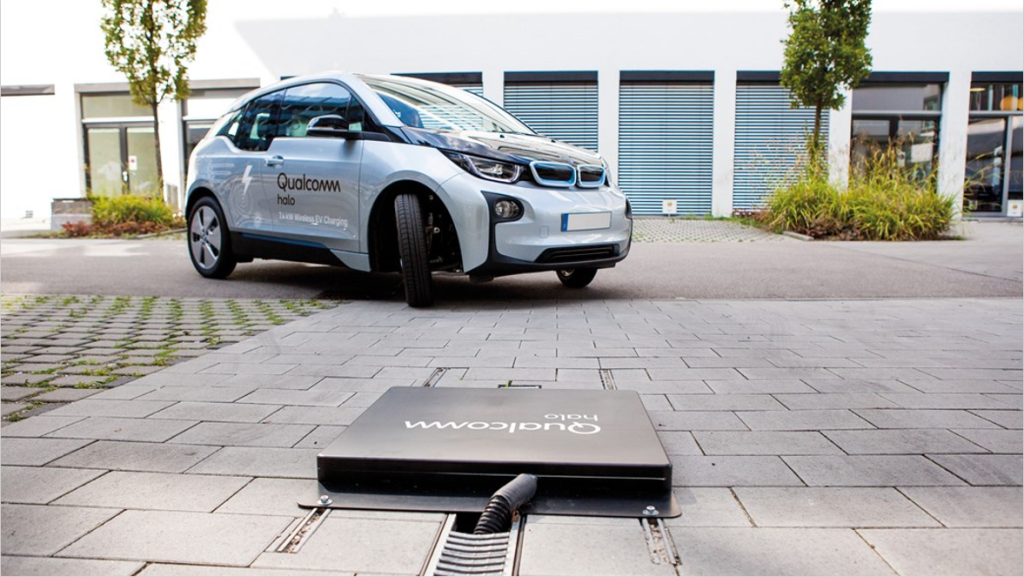
The City of Nottingham was awarded £3.4 million to trial wireless charging technology for taxis, with induction charging pads installed at Nottingham railway station.
Previously, the movement of vehicles through the taxi rank made conventional plug-in charging impractical. Wireless charging enabled taxis to remain in position while charging, helping to maintain operations and reduce downtime.
A private pilot began in summer 2021 using inductive charging technology developed by Lumen Freedom, capable of delivering charging rates of up to 11 kW.
A public demonstration programme began in August 2022 and involved nine retrofitted vehicles: five LEVC TX black cabs and four Nissan Dynamo e-NV200 vans. For more information, see the Wireless Inductive Charging for Electric Taxis (WiCET) project.
Smartroad Gotland is a 1.6 km section of inductive charging road outside Visby on the island of Gotland, Sweden. The project demonstrates how electric vehicles can charge while driving using wireless energy transfer technology embedded beneath the road surface.
The project is led by a consortium headed by ElectReon AB, which is also involved in several other trials of dynamic charging technologies.
Dynamic wireless charging has the potential to reduce battery size requirements for electric vehicles, lowering vehicle weight and improving efficiency. This could be particularly beneficial for long-distance and heavy-duty vehicles, where battery size and weight can be significant constraints.
Installation of the Smartroad Gotland system was completed in December 2020. The project concluded in September 2023 and reported positive results, demonstrating the potential of inductive road charging technology to support the future electrification of transport.
