
 Return home
Return home
Return homeUpgrade your electric vehicle (EV) charging infrastructure with advanced load management. Static load management distributes available power evenly across charge points, while dynamic load management adjusts power allocation in real time to maximise the use of available electrical capacity.
Advanced load management systems help sites with limited electrical capacity operate electric vehicle (EV) charging infrastructure more efficiently. They distribute the available electrical power across the charge points that are in use.
You may benefit from a load management system if your fleet includes:
Load management systems can allocate power according to charging priorities, helping to make the best use of available capacity and reducing the need for costly upgrades to the site’s electricity supply.
It is also important to consider future fleet growth. Installing flexible load management systems at an early stage can help accommodate additional battery electric vehicles (BEVs) and reduce the need for more extensive infrastructure upgrades later.
A standard, or static, load management system distributes a fixed amount of available power across charge points using the site’s spare electrical capacity.
Each charge point can draw power only up to its rated capacity. For example, a 7.4 kW charge point cannot deliver more than 7.4 kW, regardless of how much additional electrical capacity may be available elsewhere on the site.
The site’s maximum electrical capacity must not be exceeded, as this could overload circuits and lead to power outages. However, where electricity demand varies throughout the day or week, static load management may not make full use of the additional capacity available during periods of lower demand.
As a result, some available electrical capacity can remain unused, reducing the overall efficiency of the charging infrastructure.
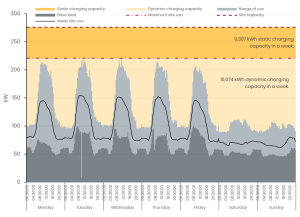
A dynamic load management system enables a site to make full use of the electrical capacity available at any given time.
When overall electricity demand on a site falls, more capacity becomes available for charging electric vehicles. Dynamic load management systems can automatically allocate this additional capacity to charging infrastructure, allowing more charge points to be installed or enabling higher charging rates without exceeding the site’s electrical limits.
These systems can also provide additional functionality, including:
User apps and radio frequency identification (RFID) cards can be linked to the charging system to track electricity consumption for individual vehicles. When combined with vehicle usage data, this information can help organisations understand how efficiently vehicles are being operated and identify opportunities for improvement.
