 Return home
Return home
Return homeA case study showcasing the key learnings from Scottish Water’s successful adoption of electric vans.
A case study showcasing the key learnings from Scottish Water’s successful adoption of electric vans.
Scottish Water provides water and sewerage services across Scotland. It is accountable to the public through the Scottish Government. Part of their work involves travelling all over Scotland, including to remote and difficult to reach locations, which see’s their fleet travelling just under 20 million miles per year.
Scottish Water has committed to achieve net zero emissions by 2040, and decarbonising their fleet is an important part of this activity with a target to transition to a zero emission fleet by 2030.
To date, Scottish Water have transitioned almost 30% of their fleet to electric vehicles. All pool cars are battery electric Nissan Ariya SUVs, which have received positive feedback in their ability to handle some of the more challenging terrain that employees need to access.
“Our team are passionate about our transport decarbonisation journey, engaging with operational drivers, addressing and alleviating their fears, mythbusting and giving them all the information they need to go electric.”
– Alison Croft, EV Transition Project Manager
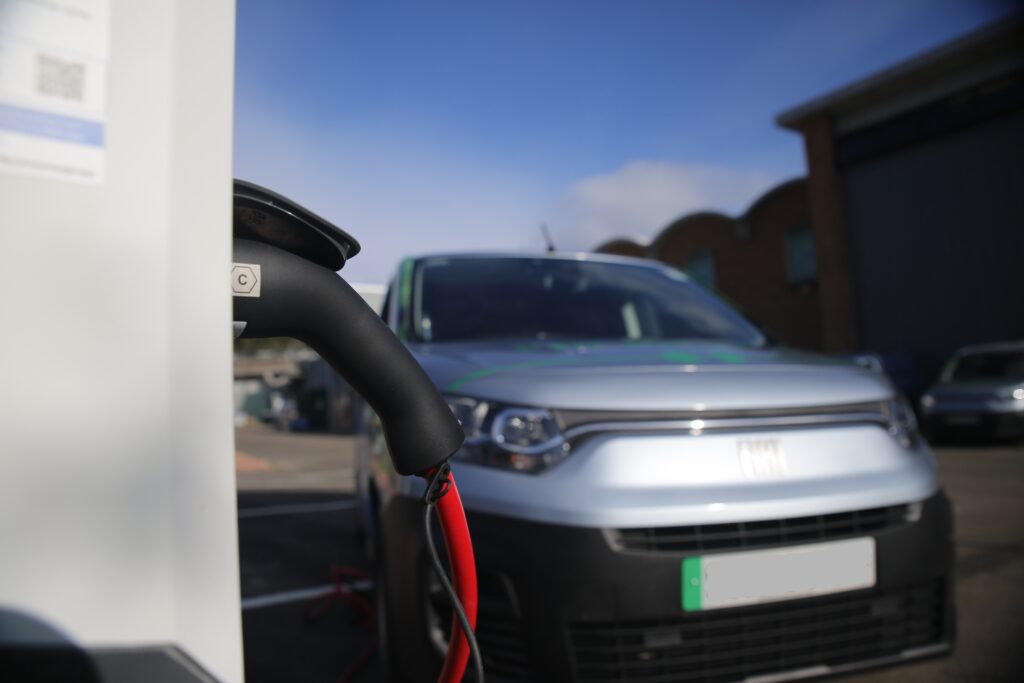
As of January 2025, Scottish Water have around 200 electric vans on the road, with many driving over 100 miles a day. They are trialling several different makes and models of fully electric vans across the country in order to test vehicle technology and capabilities.
Their electric vans range in size from the Ford e-Transit long wheelbase, currently being used in Aberdeen harbour, to Fiat E-Scudo’s, Peugeot E-Partner’s, Nissan eNV200’s and Peugeot E-Expert’s in use in Orkney.
They recently purchased:
The vans have been converted to ensure they are fit for their intended use, with adaptions including fridges for water samplers, pipe racks, tow bars, hand wash stations, lockers, and heaters to ensure Scottish Water personnel can perform their duties efficiently in all weather conditions.
“The specialised conversions of these vehicles meet our operational requirements. This enables us to provide excellent water and wastewater services for our customers. The addition of electric vans also demonstrates our commitment to reducing our carbon footprint and achieving net zero by 2040.”
-Elaine Pringle, Fleet Manager at Scottish Water
Scottish Water’s water treatment team in Orkney have completely made the switch to electric vans: 10 EV vans are in operation across Orkney, including Westray, Sanday, Eday, North Ronaldsay, and the Orkney Mainland.
Scottish Water are also planning to add electric 4×4 vehicles to the fleet, such as the Isuzu D-Max and the Munro when these vehicles become available. Another option they are considering is converting Skoda Enyaq 4×4 cars into vans, which has been done at other organisations in the UK. For difficult terrain, they ensure the right tyres are available for sites with challenging access.

To date Scottish Water have installed 370 charge points across 223 sites and plan to have charge points in 400 of their sites by 2028.
They also have two charging hub sites, and plan to have ultra rapid charging hubs in Perth, Inverness, Daldowie, and Stepps.
The majority of their chargers are Kempower 40 kW DC units, with some additional 100 kW units.
For sites with insufficient power supply, Scottish Water are looking into battery storage solutions to support charge points. In February 2025, they started a project with a 22 kW DC charge point being supported by a 63 kWh battery back-up.
A big challenge for remote sites is mobile reception, which they have been solving by installing antennas at their more remote sites.
Scottish Water have also installed 68 charge points at employees’ homes.
Initially funded by Scottish Water, the ownership of the charge points has now been transferred over to the employees and they use the AllStar payment system to ensure staff aren’t charged for business energy used on their domestic energy supply.
Having this wide availability of charge points means Scottish Water can generally avoid the use of public charging, saving on charging costs.
Scottish Water use a backoffice software platform to manage the charge points provided by Hanger19. This platform allows multiple users to use the charge points, such as pay as you go (PAYG) users, fleet users, and those with RFID cards. They operate a four-tiered tariff system for their charge points, depending on the user:
They are currently trialling a reservation system with staff, which operates similarly to booking a desk. When a charge point is booked, only the booker can use the charge point for one hour either side of the booking. The system can also send overstay reminders via text message to PAYG users.
The Hanger19 platform provides a monthly reporting of revenue, faults, and utilisation, as well as a daily offline report.
Scottish Water also intend to implement ‘auto-reset’ functionality at all their charging sites to save on maintenance time and costs.
Although Scottish Water have regular conversations with other organisations regarding the sharing of charging infrastructure, they have some concerns regarding charger sharing.
There are three key elements that have driven the success of Scottish Water’s fleet decarbonisation:
Scottish Water are demonstrating that it’s possible to implement electric fleet vans at scale in their operations across Scotland, and that electric vehicles can do the job in even the most remote and challenging locations.
Where they have come across challenges, such as insufficient power supply for chargers, they are developing solutions, such as battery-supported charge points.
Their success is also dependent on the enthusiasm of their fleet decarbonisation team, and the support they have received from senior management within the organisation which is high
