 Return home
Return home
Return homeSwitching to EVs can involve higher upfront costs but lower operating expenses. Considering total ownership costs, adjusting replacement cycles, and using carbon costing can cut long-term fleet costs and emissions.
Electric vehicles (EVs) typically have higher upfront purchase or leasing costs than equivalent internal combustion engine (ICE) vehicles, but they are often less expensive to operate. When assessing vehicle options, organisations should consider the total cost of ownership over the vehicle’s entire lifecycle rather than focusing solely on initial purchase costs.
You may wish to review vehicle replacement cycles and procurement processes to support fleet decarbonisation more cost-effectively. Taking a whole-life cost approach can help reduce long-term fleet expenditure while supporting sustainability objectives.
Total cost of ownership (TCO), also known as whole-life cost, is the total cost of acquiring, operating and maintaining an asset throughout its lifecycle. This includes purchase or lease costs, energy or fuel costs, maintenance, servicing, repairs and any residual value at the end of the asset’s life.
Adopting a procurement approach based on total cost of ownership may require a change in decision-making processes. However, it is an important part of building a more sustainable fleet. Lower-emission technologies and products often have higher upfront costs but can deliver lower operating costs, lower energy consumption and reduced emissions over their lifetime.
As petrol and diesel vehicles age, engine wear can lead to increased fuel consumption and higher emissions. Electric vehicles do not experience this type of deterioration in operation, meaning that extending their service life does not result in increased tailpipe emissions.
As the UK electricity grid continues to decarbonise, the operational emissions associated with EVs will continue to fall without any changes to the vehicles themselves. Extending vehicle replacement cycles can therefore help spread the higher upfront cost of an EV over a longer period while maximising the value of the resources and energy used during manufacturing, particularly within the battery.
To maximise return on investment, consider aligning replacement cycles with battery warranty periods. Well-maintained batteries may continue to operate effectively beyond the warranty period, potentially allowing replacement cycles of seven to ten years depending on vehicle usage and operational requirements.
Carbon costing involves assigning a monetary value to greenhouse gas emissions to reflect their environmental and societal impacts. This approach can help organisations account for the wider costs associated with carbon emissions when making investment and procurement decisions.
The UK Government uses vernment/publications/valuing-greenhouse-gas-emissions-in-policy-appraisal/valuation-of-greenhouse-gas-emissions-for-policy-appraisal-and-evaluation”>greenhouse gas emission values when assessing the environmental impacts of policies and projects. The HM Treasury Green Book also includes guidance on the use of carbon valuation within public sector appraisal and decision-making processes.
Even where no formal carbon charge is applied, organisations can use internal carbon pricing to support decarbonisation. For example, an organisation could apply an internal levy to mileage undertaken in ICE vehicles and ring-fence the resulting funds to support the purchase of EVs or charging infrastructure.
Assigning a value to emissions without an actual financial transaction is often referred to as a ‘shadow price’. Including these values within financial reporting can help illustrate the environmental impact of operations in a format that may be easier to understand and compare than tonnes of carbon dioxide emissions alone.
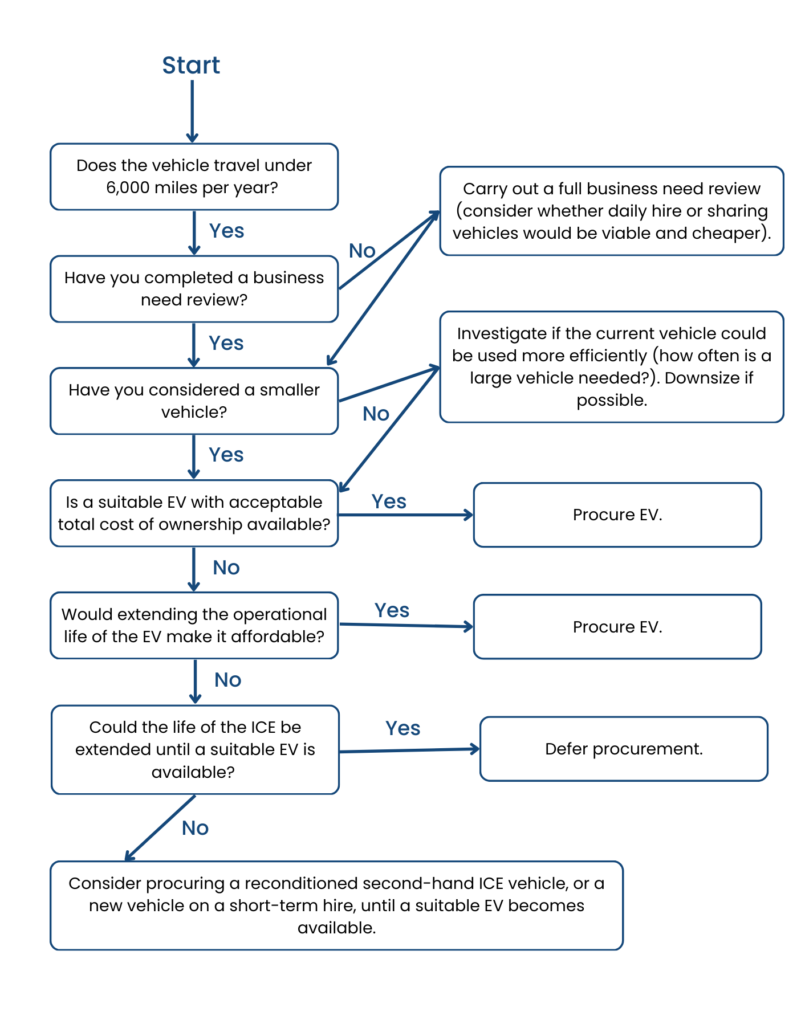
Organisations should remove unnecessary barriers to procuring electric vehicles. Where an EV can meet operational requirements, it should be considered the default vehicle choice.
If an EV is capable of meeting the operational need, requests for petrol or diesel vehicles should be challenged and supported by evidence. Procurement processes should encourage the selection of zero emission vehicles wherever practical and only consider alternative vehicle technologies where operational requirements cannot currently be met by an EV.
The diagram below illustrates a typical decision-making process, from assessing whether a vehicle is required through to selecting an electric vehicle as the default option where appropriate.