
 Return home
Return home
Return homeDiscover BEVs and explore the ranges and efficiencies. Get tips to maximise your electric vehicle range and learn about implementing driver training BEV replacement options backed up with case studies.
Battery electric vehicles (BEVs) typically have a shorter range on a single charge than most internal combustion engine (ICE) vehicles have on a full tank of fuel. For this reason, it is important to understand the different types of journeys undertaken by your fleet vehicles.
If charge points are available along vehicle routes, you may be able to use vehicles with smaller batteries that still meet operational requirements. This can reduce costs, as the battery is often the most expensive component of a BEV. It can also reduce CO2e emissions, as battery production has embedded carbon emissions.
Using a vehicle with a larger battery than necessary can also reduce efficiency because batteries add weight. Telematics data can help identify how frequently vehicles undertake high-mileage journeys. This information can be used to allocate dedicated vehicles for longer journeys while assigning smaller vehicles to shorter trips.
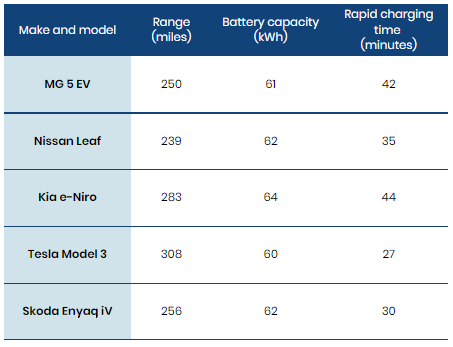
Most BEVs on the market can accept DC rapid charging. Many rapid chargers in Scotland are rated at 50kW and can typically add between 50 and 80 miles of range in 30 to 40 minutes, depending on vehicle size and efficiency.
Many second-hand BEVs cannot accept rapid charging and therefore take longer to recharge. However, they are often less expensive to purchase and may be a suitable option where rapid charging is not required. For example, vehicles with regular periods of downtime may be able to rely entirely on AC charging.
Understanding vehicle duty cycles is essential when selecting the most appropriate zero emission vehicle (ZEV) replacement. Avoid over-specifying vehicles or automatically replacing them on a like-for-like basis, as this can result in unnecessary costs and additional embodied carbon emissions.
A high-mileage vehicle that makes regular stops throughout the day may have opportunities for multiple top-up charges. This can increase the effective daily range of an electric vehicle and make lower-specification models a viable option. However, suitable charging infrastructure must be in place to support this approach. Read more about charging infrastructure.
BEV efficiency, often measured in miles per kWh (mi/kWh) in the UK and watt-hours or kilowatt-hours per kilometre elsewhere, can be affected by factors such as vehicle weight, battery size, aerodynamic drag and motor type. Before purchasing a vehicle, it is important to understand requirements relating to range, charging capability and vehicle size. Choosing the most efficient model available can reduce running costs and maximise CO2e savings.
Public perceptions of BEV range are often lower than the reality. Figure 18 shows distances in five-mile increments up to 25 miles from Edinburgh city centre. The outer edge represents a 50-mile round trip, which is achievable for most BEVs, including fully laden battery electric light commercial vehicles operating in poor weather conditions.
It is essential to understand the real-world range of a BEV when assessing whether it can replace a particular ICE vehicle. It is equally important to identify charging opportunities along routes or during shifts where necessary.
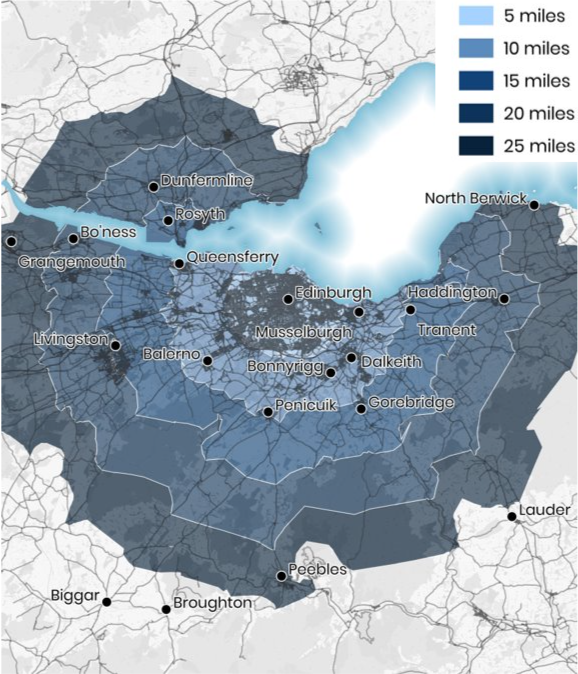
Figure 18 – 25 mile range map from Edinburgh in 5 mile increments
Changes in weather conditions and temperature can affect the range of electric vehicles (EVs).
A study by the American Automobile Association found that EV range decreased by up to 41% when operating at temperatures of -6°C with the heating switched on. This is due to the impact of cold weather on battery performance. Low temperatures slow the electrochemical reactions within lithium-ion batteries, reducing their ability to deliver energy efficiently.
Cold weather can also increase charging times. This can be managed by following some of the recommendations outlined below. It is also important to recognise that route planning may need to be adjusted during colder periods to account for reduced vehicle range.
After the power drawn by the motor, the cabin heater is the biggest drain on an EV’s battery. Having the cabin heater on can reduce range by up to 30%. By pre-heating the cabin whilst plugged into a charge point, it will be at a comfortable level at the time of entering, therefore won’t use as much charge to maintain this temperature during the journey.
This will pre-heat the battery. A warmer battery will discharge power more efficiently, thereby maximising range available when commencing a journey.
Adopting an anticipatory driving style – avoiding abrupt starts and stops – will help get the most out of a battery’s range.
The battery will charge at a quicker rate when warm. As the battery is warmed by heat generated in the powertrain when driving, charging the vehicle immediately upon stopping – before the battery can cool back down – will maximise the charging rate. If the battery is cold, the molecular action in the battery slows down, reducing its ability to accept charge.
Improving driving behaviour can reduce both fleet emissions and operating costs.
Fuel-efficient driving, often referred to as eco-driving, involves techniques that maximise vehicle efficiency. Most of these techniques apply to both internal combustion engine (ICE) vehicles and battery electric vehicles (BEVs). In ICE vehicles, eco-driving can reduce fuel consumption, leading to lower carbon emissions and improved air quality. Eco-driving also places a strong emphasis on anticipation and forward planning, which can help improve road safety.
Adopting the recommendations below could help deliver initial savings of up to 15% in both fuel costs and carbon emissions, while also helping drivers maximise the range of electric vehicles within the fleet.
Anticipate situations and other road users as far ahead as possible to avoid unnecessary braking and acceleration.
When slowing down or driving downhill, remain in gear but remove your foot from the accelerator. This will remove unnecessary strain from the engine and reduce fuel consumption.
When accelerating, shift to a higher gear early. This will reduce strain on the engine, improving fuel consumption.
High speeds greatly increase fuel consumption
Air conditioning adds to the fuel/battery consumption.
Turn off your engine when you’re likely to be stationary for 10 seconds or longer. According to the RAC, stop start engines that automatically cut out idling can reduce air pollution from that vehicle by 20%.
Remove racks, roof boxes and bike carriers when not in use, as these significantly increase air resistance and fuel consumption at higher speeds.
Any added weight will increase fuel consumption.
Service your vehicle regularly. Ensure tyre pressure is correct.
We have created 24 model-specific introductory videos for popular electric vehicles. These videos provide a useful starting point for staff who are unfamiliar with electric vehicle technology or specific vehicle models.
If your fleet operates in rural areas, it may include off-road vehicles. These can be more challenging to replace, as there are currently relatively few zero emission alternatives available. Some pick-up trucks and off-road vehicles are classified as light commercial vehicles (LCVs) by the DVLA. This may provide additional time to transition to a zero emission alternative, as the government’s target for LCVs extends to 2030. This additional time should allow the market to mature and provide a wider range of replacement options.
Several vehicles are expected to enter this market over the coming years. Table 17 provides examples of potential options, together with estimated fuel costs and CO2e emissions associated with travelling 10,000 miles. As some of these vehicles are not yet in full production, the figures shown are estimates.
| Savings per vehicle | Munro 4x4 EV | Rivian RIT Pickup | Maxus T90 Pickup (2x4) |
|---|---|---|---|
| EV Range | 200 (estimated) | 270-410 (estimated) | 330 (WLTP range) |
| Expected UK release | To order | On sale in US (UK planned) | Available |
| Comparison annual miles (1) | 10000 | 10000 | 10000 |
| Official CO2 per km (2) | 0 | 0 | 0 |
| Annual CO2e (tonnes) (3,4) | 0.63 | 0.84 | 0.80 |
| Annual fuel costs (5) | £868 | £1,144 | £1,099 |
| First year VED (6) | £0 | £0 | £0 |
| First year costs (fuel+VED) | £868 | £1,144 | £1,099 |
The options for decarbonising minibuses and multi-purpose vehicles have increased rapidly in recent years. Many manufacturers now offer purpose-built minibus bodies based on battery electric van chassis.
The table below provides examples of electric minibuses, together with estimated fuel costs and CO2e emissions associated with travelling 10,000 miles. It also includes the New European Driving Cycle (NEDC) or Worldwide Harmonised Light Vehicle Test Procedure (WLTP) range, along with the approximate seating capacity of each model. This information can help you determine which vehicle is most suitable for your operational requirements.
| Savings per vehicle | Mellor Eleos | LDV EV80 | Mercedes eVito Tourer | Peugeot e-Traveller |
|---|---|---|---|---|
| EV range (miles) | 100 (NEDC Range) | 120 (NEDC Range) | 221 (WLTP Range) | 148 (WLTP Range) |
| Passenger seats | 16-23 | 15 | 8 | 8 |
| Comparison annual miles (1) | 10000 | 10000 | 10000 | 10000 |
| Official g CO2 per km (2) | 0 | 0 | 0 | 0 |
| Annual CO2e (tonnes) (3,4) | 2.66 | 1.26 | 1.32 | 0.98 |
| Annual fuel costs (5) | £3,649 | £1,722 | £1,795 | £1,340 |
| First year VED (6) | £0 | £0 | £0 | £0 |
| First year fuel costs (fuel+VED) | £3,649 | £1,722 | £1,795 | £1,340 |
AA (2023). Fuel price report (September 2023).
DESNZ (2023). Greenhouse gas reporting: conversion factors 2023.
There were more than 21,700 licensed taxis and private hire vehicles in Scotland in 2022 (Scottish Transport Statistics). Due to their typically high annual mileage and concentration in urban areas, these vehicles can have a significant impact on local air quality and greenhouse gas emissions. The adoption of electric vehicles (EVs) within the taxi and private hire sector plays an important role in improving air quality, supporting public health and helping to address climate change.
Battery electric vehicles (BEVs) produce zero tailpipe emissions, making them an effective solution for improving air quality, reducing greenhouse gas emissions and supporting the transition to more sustainable transport systems.
Benefits
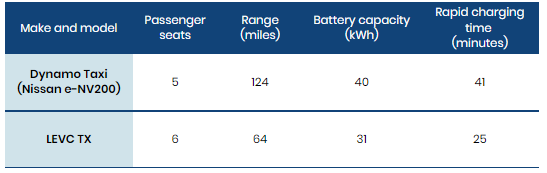
Local action can help accelerate the electrification of taxi and private hire fleets by making electric vehicles more convenient, cost-effective and attractive than higher-emitting alternatives.
Encouraging early adoption of electric vehicles among taxi and private hire operators can reduce both air pollution and greenhouse gas emissions. It can also help drivers prepare for the transition away from petrol and diesel vehicles by giving them experience of operating electric vehicles before future regulations take effect.
Dundee City Council expanded its electric taxi and private hire fleet and now has one of the highest concentrations of electric vehicles (EVs) in the UK. Effective communication has been central to the success of Dundee’s transition. The council held quarterly meetings with the trade to understand the challenges faced by drivers, which informed the development of a range of policy measures, including:
Providing accessible charging infrastructure has been another critical factor in Dundee’s electrification journey. The number of public charge points has continued to grow since the first installations in 2011, with 253 charge points now available across the city.
In 2019, the council installed a solar-powered charging hub featuring dynamic load management technology and 20 charging bays.
Dundee now has three charging hubs using this system, with a fourth planned. EV taxi and private hire drivers were given priority access to these facilities and were initially able to charge free of charge.
As a result of these measures, 165 electric taxis now operate in the city, representing around 25% of Dundee’s taxi fleet.
