 Return home
Return home
Return homeA case study showcasing the key learnings from Scottish Water’s successful adoption of electric vans.
This case study highlights the key lessons learned from Scottish Water’s successful adoption of electric vans.
Scottish Water provides water and wastewater services across Scotland and is accountable to the public through the Scottish Government. Its operations require travel throughout the country, including to remote and hard-to-reach locations. As a result, its fleet travels almost 20 million miles each year.
Scottish Water has committed to achieving net zero emissions by 2040. Decarbonising its fleet is a key part of this commitment, with a target to transition to a zero emission fleet by 2030.
To date, Scottish Water has transitioned almost 30% of its fleet to electric vehicles. All pool cars are battery electric Nissan Ariya SUVs, which have received positive feedback from staff for their ability to operate effectively in some of the more challenging terrain that employees are required to access.
“Our team are passionate about our transport decarbonisation journey, engaging with operational drivers, addressing and alleviating their fears, mythbusting and giving them all the information they need to go electric.”
– Alison Croft, EV Transition Project Manager
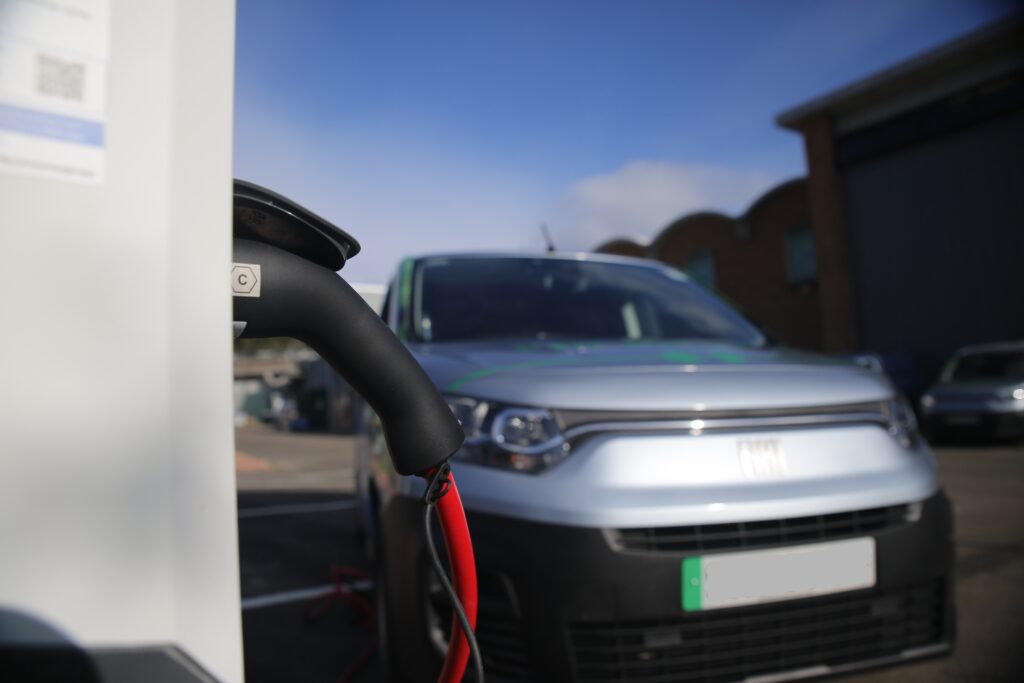
As of January 2025, Scottish Water operates around 200 electric vans, many of which travel more than 100 miles per day. The organisation is trialling a range of fully electric van models across Scotland to assess vehicle performance, suitability and operational capability in different environments.
The electric van fleet includes vehicles ranging from long-wheelbase Ford E-Transit models operating in Aberdeen Harbour to Fiat E-Scudo, Peugeot E-Partner, Nissan e-NV200 and Peugeot E-Expert vans deployed in locations such as Orkney.
Recent vehicle purchases include:
The vans have been modified to meet operational requirements, with adaptations including refrigerators for water sampling activities, pipe racks, tow bars, hand-washing facilities, storage lockers and heating systems. These modifications help ensure Scottish Water employees can carry out their duties safely and efficiently in a range of weather conditions and operational environments.
“The specialised conversions of these vehicles meet our operational requirements. This enables us to provide excellent water and wastewater services for our customers. The addition of electric vans also demonstrates our commitment to reducing our carbon footprint and achieving net zero by 2040.”
-Elaine Pringle, Fleet Manager at Scottish Water
Scottish Water’s water treatment team in Orkney has fully transitioned to electric vans. Ten electric vans are now operating across Orkney, including on Westray, Sanday, Eday, North Ronaldsay and the Orkney Mainland.
Scottish Water is also planning to introduce electric four-wheel-drive vehicles to its fleet, including models such as the Isuzu D-Max and the Munro, when they become available. Another option under consideration is the conversion of Škoda Enyaq 4×4 vehicles into vans, an approach already adopted by some organisations elsewhere in the UK. For locations with challenging access requirements, Scottish Water ensures that vehicles are equipped with suitable tyres to enable safe and effective operation in difficult terrain.

To date, Scottish Water has installed 370 charge points across 223 sites and plans to expand this network to 400 sites by 2028.
The organisation also operates two charging hubs and plans to introduce ultra-rapid charging hubs in Perth, Inverness, Daldowie and Stepps.
Most of Scottish Water’s charging infrastructure consists of Kempower 40kW DC chargers, supplemented by a number of 100kW units.
For sites with limited grid capacity, Scottish Water is exploring battery storage solutions to support charging infrastructure. In February 2025, the organisation began a project using a 22kW DC charge point supported by a 63kWh battery storage system.
Providing charging infrastructure at remote sites has presented challenges, particularly in relation to mobile network coverage. To address this, Scottish Water has installed antennas at some of its more remote locations.
Scottish Water has also installed 68 charge points at employees’ homes.
Although these charge points were initially funded by Scottish Water, ownership has since been transferred to employees. The organisation uses the Allstar payment system to ensure staff are reimbursed for business-related charging costs and are not personally charged for electricity used for work purposes.
The extensive availability of charging infrastructure across Scottish Water’s estate and employees’ homes helps minimise reliance on public charging networks, reducing charging costs and supporting efficient fleet operations.
Scottish Water uses a back-office charge point management platform provided by Hanger19. The platform supports a range of user groups, including fleet drivers, pay-as-you-go (PAYG) users and RFID card holders. Scottish Water operates a four-tier tariff structure based on user type:
Scottish Water is also trialling a charge point reservation system for staff, which operates in a similar way to desk booking systems. When a charge point is reserved, access is restricted to the person making the booking from one hour before until one hour after the reserved time. The system can also send overstay reminders via text message to PAYG users.
The Hanger19 platform provides monthly reports covering revenue, charger faults and utilisation rates, as well as daily reports highlighting any charge points that are offline.
Scottish Water also plans to implement automatic reset functionality across its charging network to reduce maintenance requirements and minimise operational downtime.
Although Scottish Water regularly engages with other organisations to discuss opportunities for sharing charging infrastructure, it has identified several challenges associated with this approach.
Scottish Water has identified three key factors that have contributed to the success of its fleet decarbonisation programme:
Scottish Water is demonstrating that electric vans can be deployed successfully at scale across a large and geographically diverse fleet. Its experience shows that electric vehicles can operate effectively even in some of Scotland’s most remote and challenging locations.
Where operational challenges have arisen, such as limited electrical capacity for charging infrastructure, Scottish Water has developed practical solutions. These include the use of battery-supported charging systems to overcome local power constraints.
The success of the programme has also been driven by the commitment and enthusiasm of Scottish Water’s fleet decarbonisation team, together with strong support from senior management. This combination of operational expertise, strategic leadership and investment has helped accelerate the organisation’s transition to a zero emission fleet.
