 Return home
Return home
Return homeDiscover the benefits of active travel for employers and employees. Read case studies from Sustrans on cycling and get more information on how to adopt an ebike or eCargo bike.
Active travel can benefit both your organisation and your employees.
There are many advantages to encouraging active travel. As an employer, you can help promote healthier and more active lifestyles, while supporting employees to achieve a better work-life balance. Studies have found that active travel can significantly reduce sickness absence among employees. Visit the Sustrans website for more information.
There can also be financial benefits for employers. Some organisations have reported:
See the table below for examples of potential cost, emissions and time savings. The comparison assumes a two-mile city-centre journey. Cycling is typically the fastest and most efficient mode of travel, resulting in very low, if any, emissions and costs.
| Petrol or diesel car | electric bike | Pushbike | Walk | |
|---|---|---|---|---|
| Miles | 2 | 2 | 2 | 2 |
| Cost per mile | £0.14 (1) | £0.003 (2) | £0 | £0 |
| Emissions per mile (gCO2e) | 276 (3) | 3.8 (4) | 0 | 0 |
| Average speed (miles per hour) | 6.6 (5) | 13.75 (6) | 12 (7) | 3 (8) |
| Total costs | £0.27 | £0.01 | £0 | £0 |
| Total emissions (gCO2e) | 551.9 | 7.6 | 0 | 0 |
| Total journey time (minutes) | 18 | 9 | 10 | 40 |
To support staff who want to cycle to work, you should provide facilities such as changing rooms, lockers and secure cycle storage.
You can also help employees switch to active travel by providing pool bikes, e-bikes or e-cargo bikes.
Financial incentives can also encourage cycling. Employees can claim up to 20p per mile for business journeys made by bicycle. It is important to promote this incentive within your organisation.
The UK Government’s Cycle to Work Scheme can be offered as an employee benefit. The scheme is free for employers to join and can help employees save up to 49% on the cost of a new bicycle and cycling equipment through salary sacrifice.
Other incentives may also encourage greater uptake of active travel. These could include prizes, subsidised gym or sports memberships, and organised walking or cycling events.
E-bikes can improve your workforce’s health and reduce carbon emissions by replacing vehicle journeys.
An e-bike is an electrically assisted pedal cycle. It has an electric motor that provides power assistance when the rider is pedalling, reducing the amount of effort required. The motor is powered by a battery that can be charged using a standard three-pin socket.
Because e-bikes make cycling easier, employees may be more willing to use them and travel further. This can increase the number and length of car journeys that can be replaced by active travel.
The electricity costs associated with e-bikes are also very low. Cycling 100 miles on an e-bike can cost as little as 30p in electricity when charged at home*.
We recommend trialling pool e-bikes. You could also consider providing cycle training to support uptake among staff. Several organisations have found that this approach helps build cycling confidence and demonstrate the travel opportunities that e-bikes offer.
Cycling Scotland currently offers a suite of cycle training programmes to support workplaces with pool bike adoption. It also offers funding towards installing cycling infrastructure in the workplace.
*Assuming a 36V battery, an electricity cost of £0.17 per kWh and a conservative 25-mile range.
E-bikes are less physically demanding than conventional bicycles, particularly on hilly terrain. They are a good option for people who may find riding a traditional bicycle too physically challenging.
They may also be more appealing for work-related journeys, as riders can avoid arriving at their destination exhausted and overheated.

E-cargo bikes can replace some light commercial vehicle mileage and are cycles designed to carry loads. They are available in a range of configurations and can be adapted to suit specific operational requirements. They can carry loads of up to 350kg and offer load volumes of up to 1m3. As a result, e-cargo bikes are well suited to logistics operations and short-distance deliveries within urban areas and between operational sites.
E-cargo bikes offer similar cost and CO2e savings to standard e-bikes. However, their greater weight means they typically have slightly higher running costs. Travelling 100 miles on an e-cargo bike can cost around 28p in electricity, which is still significantly cheaper than using a car or van.
If you introduce e-cargo bikes into your fleet, we recommend implementing a training programme. Familiarisation training can reduce the risk of injury, increase staff confidence and improve willingness to use the bikes. High levels of staff uptake will help maximise the financial and environmental benefits.

Mid Sussex Electrical operates across south-east England and London. Its customers include property developers, utility companies, outdoor markets, public transport providers and seafood suppliers.
The company estimates that it saves around £100 per trip by using an e-cargo bike instead of a van, primarily by avoiding congestion charges.
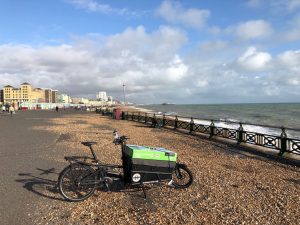
Using an e-cargo bike has also enabled the company to undertake work in locations that are difficult to access by van, such as shopping centres in Brighton. Employees can take the bike directly into a client’s premises, avoiding the need to park elsewhere and carry heavy tools over long distances.
Mid Sussex Electrical Ltd estimates that it has eliminated 2,500 van miles per year, reducing emissions by approximately 0.99 tonnes of CO2e (Energy Saving Trust, 2021c).