
 Return home
Return home
Return homeExplore hydrogen fuel cell electric HDVs and key attributes and discover the different ranges of FCEVs. Read case studies from Aberdeen City Council, The City of Edinburgh Council, Glasgow City Council and Dundee City Council.
Hydrogen has the potential to provide a low-carbon solution for hard-to-decarbonise sectors, including heavy-duty vehicle (HDV) transport.
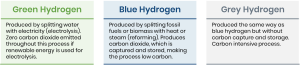
Hydrogen can be produced by splitting water using electricity (electrolysis) or by reacting fossil fuels with steam to produce hydrogen (reforming).
Hydrogen is the lightest and most abundant element in the universe and contains more energy per unit of weight than any fossil fuel. When used in a fuel cell vehicle, hydrogen produces only water at the tailpipe. It can also be produced with very low emissions when renewable electricity is used in the production process (see figure below).
Aberdeen City Council has deployed a wide range of fuel cell electric vehicles (FCEVs) within its fleet. The council has participated in numerous FCEV demonstration projects, including trials involving buses, refuse collection vehicles, passenger cars and light commercial vehicles.
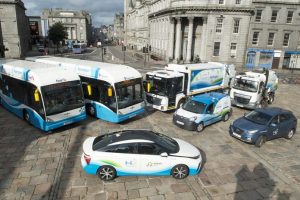
Image source: Open Access Government, 2020
Hydrogen fuel cell electric vehicles (FCEVs) are at an earlier stage of development than battery electric vehicles (BEVs). The relatively short list of examples below reflects the limited number of hydrogen-powered heavy-duty vehicles (HDVs) currently available on the market compared with battery electric alternatives. However, the range of FCEV HDVs is expected to grow as the technology and supporting infrastructure continue to develop.
| Make and model | GVW (tonnes) | Range | Details |
|---|---|---|---|
| Alexander Dennis H2.0 (Enviro400FCEV) | TBA | 300 miles | Double decker bus powered by a 340kW motor. |
| Hyundai Xcient Fuel Cell (2021) | 36 or 40 tonnes | 250 miles | Two 90kW fuel cells convert hydrogen into electricity, powering a 350kW motor. 31kg hydrogen fuel tank on board. |
| Solaris Urbino 12 | 19 tonnes | 217 miles | Single deck bus, up to 37 seats. 70kW hydrogen fuel cell powering 2x125kW motors. 5x312 litre hydrogen tanks. |
| Mercedes-Benz GenH2 | TBA | 620 miles | Two 150kW fuel cells supply two 230kW motors, with battery providing an additional 400kW of temporary power if required. The vehicle can store up to 80kg of liquid hydrogen. |
| Toyota and Hino Profia | 25 tonnes | 370 miles | Toyota and Huno Profia are developing a new large capacity high pressure (70MPa) hydrogen tank, however there has been little news since 2020. |
| Hyzon Hymax Series | 24, 46, 70 tonnes | 250-370 miles | 80 or 240kW fuel cell drive a 160 or 450kW motor. Can carry either 30 or 70kG hydrogen depending on size. |
| Hyzon Econic Refuse | 64 tonnes | 125 miles | A 110kW fuel cell and battery powers a 240kW motor. |
| Nikola Tre FCEV | TBA | 500 miles | Day cab long-haul truck. Two 100kW fuel cells are combined with two 70kWh batteries. Tank capacity is estimated to be around 70kg of hydrogen. |
| Nikola Two FCEV | TBA | 900 miles | Sleeper cab long-haul truck. |
The City of Edinburgh Council replaced one of its Bucher V62 diesel sweepers with an electric equivalent, the MaxPowa V62e. The electric sweeper is equipped with a 200kWh battery and two 22kW onboard chargers, enabling it to charge from 10% to 100% in under five hours. Transport Scotland provided funding covering 50% of the vehicle’s £368,000 purchase cost.
The electric truck-mounted sweeper is one of four such sweepers operated by the council, with the remaining three vehicles powered by diesel. These sweepers are used on larger roads across Edinburgh, primarily during overnight operations, alongside the council’s fleet of compact municipal sweepers. The low noise levels of the electric vehicle have made it particularly well suited to night-time use.
The council has found that the electric sweeper performs at least as effectively as its diesel counterparts. After completing its operational duties, the vehicle typically returns with around 40% battery charge remaining, regardless of season or weather conditions.
The sweeper is supported by a dedicated three-phase charging point installed at one of the council’s depots. Installation costs were approximately £1,000, with a specification similar to that required for an electric car or light commercial vehicle.
The vehicle has been integrated into existing fleet operations with minimal disruption and follows the same routine safety inspection procedures as the diesel model it replaced.
Glasgow City Council received a capital grant from Transport Scotland, alongside funding from the Office for Zero Emission Vehicles (OZEV), to replace one of its diesel refuse collection vehicles (RCVs) with a hydrogen fuel cell demonstrator vehicle. The council has also ordered 19 hydrogen fuel cell RCVs, developed by Dennis Eagle and Ballard, for delivery over the coming years.
Glasgow has expanded its adoption of hydrogen technology beyond refuse collection vehicles and now operates 20 hydrogen-diesel hybrid gritters converted by ULEMCo. Although the hydrogen fuel cell RCVs have not yet entered full operation, the demonstrator vehicle has been showcased at a number of events, including the All-Energy and Decarbonise 2022 conference in Glasgow.
Hydrogen for these vehicles is supplied through Nanosun’s trailer-based refuelling station, located at the council’s Gartcraig depot. Ensuring the use of green hydrogen is a key priority for Glasgow City Council. Hydrogen purity is also critical to protect fuel cell performance and longevity, meaning the council’s hydrogen supply contract includes stringent fuel quality requirements.
The demonstrator fuel cell RCV has performed effectively in daily operations. However, some concerns have been raised regarding vehicle range. As additional vehicles enter service, Glasgow will continue to build experience and identify the routes and applications most suited to hydrogen technology.
Before deploying the vehicles, Glasgow carried out detailed route risk assessments. The hydrogen storage tanks, which are mounted on the vehicle roof, were identified as a potential collision risk. As a result, protective guards were installed over the tanks as a straightforward and effective risk mitigation measure.
Maintenance planning was also an important consideration. Manufacturer support is provided through the vehicles’ five-year warranty, while the council plans to develop in-house expertise to support future maintenance requirements.
Another key consideration was vehicle recovery planning. Glasgow needed to ensure that recovery providers could safely recover both hydrogen fuel cell and battery electric vehicles, which are generally heavier than equivalent internal combustion engine (ICE) vehicles.
Aberdeen City Council has adopted a range of alternatively fuelled heavy-duty vehicles (HDVs). These include hydrogen fuel cell refuse collection vehicles (RCVs), hydrogen-diesel dual-fuel RCVs, hydrogen-diesel dual-fuel truck-mounted sweepers (TMSs) and electric municipal sweepers. The council previously operated an EMOSS-converted Mercedes Econic electric RCV, although this was later withdrawn from service due to performance issues.
Working in partnership with ULEMCo, Aberdeen has converted nine vehicles to operate on a hydrogen-diesel dual-fuel system. These include six refuse collection vehicles, two truck-mounted sweepers and one JCB vehicle. The RCVs range from 12 to 26 tonnes, with each conversion costing approximately £45,000. The council reported that these vehicles performed as effectively as their diesel equivalents. The truck-mounted sweeper conversions cost approximately £40,000 per vehicle.
The council initially had concerns about the potential impact of vehicle conversions on manufacturer warranties. However, no significant issues were encountered in practice.
Aberdeen refuels its hydrogen vehicles at a hydrogen refuelling station located adjacent to its waste depot and operated in partnership with BOC. The council is also working with BP to expand refuelling provision for the fleet. Staff received training in the use of high-pressure hydrogen refuelling equipment, as well as general vehicle operation and safety procedures.
Each of Aberdeen’s dual-fuel HDVs travelled approximately 1,000km during June 2022. Most of this mileage was completed using hydrogen rather than diesel, resulting in carbon dioxide savings of almost 2.5 tonnes during the month. Vehicle data indicates that high levels of hydrogen substitution can deliver significant emissions reductions, even where vehicle mileage is relatively low.
Using funding support from Transport Scotland, Dundee City Council procured a Dennis Eagle eCollect refuse collection vehicle (RCV) and a Johnston CityCat V20 electric sweeper. Transport Scotland funding covered £185,428 of the eRCV’s £376,865 purchase cost and £187,088 of the eSweeper’s £375,029 purchase cost.
This case study focuses on the performance of the Dennis Eagle vehicle. The eRCV is now one of six electric refuse collection vehicles operating within Dundee’s fleet and has been in service for more than 18 months.
Dundee initially deployed the vehicle on shorter collection routes to better understand its energy consumption during driving and bin collection operations. Following successful trials, the vehicle was introduced onto longer routes. As Dundee is a relatively compact and flat city, energy consumption from driving is comparatively low. The council found that measuring performance in terms of the number of bin uplifts completed per shift provided a more useful indicator than mileage alone.
One of Dundee’s drivers, who is also a qualified trainer, received specialist training in the operation of the electric RCV before training the wider driver team. Drivers have reported positive experiences, describing the vehicle as easy to operate and noting that the bin-lifting mechanisms perform similarly to those on equivalent diesel vehicles.
Each vehicle has a combined battery capacity of 300kWh and can charge at rates of up to 50kW. Dundee found that overnight charging at 25kW best suited its operational requirements. The vehicles do not need to be fully charged every night because daily operations do not fully deplete the battery. The council currently allocates a dedicated charger to each electric RCV.
One challenge encountered with this vehicle model was the location of the charging port. Positioned near the front of the vehicle, where the fuel filler would typically be located on a diesel model, the charging port was some distance from the charging equipment when vehicles were reverse-parked for safety reasons. To overcome this issue, Dundee purchased extended charging cables capable of reaching the charging port.
The public response to the vehicles has been positive. Engagement activities included a competition inviting residents to name the vehicles. The winning names, inspired by popular culture, were “Bin Diesel” and “Leonardo Di Charge-io”.
From an environmental perspective, Dundee estimates that replacing a diesel refuse collection vehicle with an equivalent electric model saves approximately 19,620kg of emissions each year. The council is committed to further fleet decarbonisation and has set a target to replace its remaining 30 refuse collection vehicles with electric alternatives before 2030.
